Ironman World Championship Race Report - Oli Fischer
“E ala e!” The Hawaiian morning chant comes over the loudspeakers, loud enough for me to hear it at the start line out in the water. I am warming up, it is 06:50, a quarter of an hour before the start…

“E ala e!” The Hawaiian morning chant comes over the loudspeakers, loud enough for me to hear it at the start line out in the water. I am warming up, it is 06:50, a quarter of an hour before the start of the 41st Ironman Hawaii in history. I have been up for two hours, the routine of breakfast, oiling up and applying sun cream behind me, and a good hour ago Eva and I drove down by car as close to the start area as we could get. Behind the King Kamehameha Hotel, which sits more or less at the heart of the event, I submitted to the body painting: a friendly lady stuck my race number onto my forearm. The volunteers at this event are extraordinarily friendly, in fact. There are hundreds of them, and they have travelled here from all over the world to help out at this anniversary event for free and to experience the myth of Ironman Hawaii for themselves - exactly like me, just from a different perspective. Even here, long before the race, their enthusiasm creates an atmosphere I have never known at any race. At every station I passed on my way into transition, people wished me good luck and a good race. Same at the weigh-in. 142.8 pounds is what the girl noted down in her list, together with my race number, so they can see how badly dehydrated I am should I have to pay an involuntary visit to the medical tent today. To head that off, I fitted my three drinks containers to the bike while I was in transition. Tyre pressure is fine, and luckily I only clipped the shoes in this morning, because the overnight rain soaked everything. The rain has brought the temperature down, in fact, and it is a little cooler today than on the previous days. Some forecasts even mention further showers this afternoon. An Ironman in the rain in Kona? - Unthinkable! But possible: only last Monday it rained solidly all afternoon. Ten minutes to the start. I swim up and down the bay one more time. Twenty minutes ago, right after the stirring American national anthem and a selfie in front of the finish arch, Eva kissed me goodbye. She had tears in her eyes and told me to take care of myself out there. “Of course, see you later!” - Naturally I only have an inkling of what is waiting for me today. I certainly have respect for the heat, and a little uncertainty is floating around too, given that my last completed long distance is more than a year ago now! But in the end it is not much more than an Ironman in hot conditions. There will be no great white sharks waiting for me in the water, no hurricane will blow me off the bike, and I will not have to run away from glowing lava flows. Besides, today the Olympic ideal is what counts for me: taking part is everything. And finishing. The rest is cosmetics. I want to enjoy the event as much as I can, and it would be nice to cross the line before sunset. (Sunset is at 18:00, which means a time of under eleven hours is the target.) Whether I am classified 100th or 200th in my age group this evening is irrelevant. I am not going to compromise the dream of becoming a Kona finisher for anything. I will take it easy. Bring it home! Five minutes to the gun. The pros have been on their way for almost half an hour. Who is leading, I wonder? Will Lange leave everyone standing on the marathon again? Or will Gomez show everybody straight away who the king of triathlon over all distances is? Or can Sanders pull off the really big surprise? Will Kienle blow up again? Will Wurf set another bike record? Will there be any new course records at all? And does Daniela Ryf stay unbeaten? I do slightly regret not being able to follow the pro race live on the telly at home on the kouch, sorry, couch. But being here live is not bad either. And if I get a move on, I might cross paths with the winner in his final metres on Hualalai Road, or even on the famous Palani Road. Together with a good 1,700 other triathletes I line up for the water start along the start line, which is more than a hundred metres wide, on the far right, about five rows back. The nervousness of the crowd is palpable, almost contagious. But oddly enough I am not nervous at all, just as I have not been over the past hours and days. I have probably slowly become an old hand, seasoned. I know what I can ask of my body and my mind, and I trust that nothing bad will happen to me here in Hawaii, the home of my soul. Treading water with hundreds of people around me is not exactly pleasant, though. Every few seconds you touch one of your roughly six neighbours, and I hope nobody panics and starts lashing out or clinging on to others. A glance at the watch: 07:03. The releasing gun will come soon. I start my stopwatch. 07:05. John Collins, the man who invented the Ironman on Oahu 40 years ago, fires the cannon together with his wife Judy and sets off the anniversary edition of Ironman Hawaii - bang! The water at the start line begins to boil in an instant as the good 1,700 athletes around me get moving. Me too.
The first twenty minutes are pure survival. Nothing but thrashing arms and legs around me. White water. No way out. I am trapped in a current of people who all swim at roughly the same speed as me. Which means the situation is pretty much deadlocked. I try to stay calm and to find something like a rhythm, to adapt my breathing to the circumstances: sometimes every two strokes to the left, sometimes every two to the right, sometimes every three... Orientation and choosing your own line are illusory; I simply drift along in the stream. I do not see any dolphins, by the way, and no jellyfish either. Just the occasional pale blue swim cap gliding past beneath me in the dark blue. At the Body Glove boat, halfway through the swim, the field has spread out a little. I risk a quick glance at my watch: 29:42. The current has probably helped a bit. There are still dozens swimming right next to me, but at least you are not in constant body contact, and the gaps allow reasonably free swimming and breathing and, to a limited extent, a line of your own. My arms are slowly turning to jelly. If only I had swum a bit more these past weeks! Buoy by buoy I fight my way towards the exit. I am bored. Every so often I try to swim with a bit more power, to get out of the draft of the man in front, but all that changes is the order among us; it does not make me any faster. After a good hour I reach the last hundred metres. Now that everything converges again, the jostling starts all over. Damn it! One guy overtakes me in the final twenty metres as if he had been stung by a tarantula, and whacks me on the head in the process. Yo bro’, you just gained five seconds and moved from 706th to 705th. Congratulations, arsehole! I try to find my aloha spirit again quickly, and remind myself what a privilege it is to be here today. It is a once-in-a-lifetime experience and I have to enjoy it. Idiots are simply part of triathlon. That is nothing new. It was the same back in 1996 at secondary school, when Griesser (that was his name, I think) sent word to me across the school yard, via one of his few friends, that he was going to “saw me in half” at the sports-day triathlon. He did not have the guts to tell me himself. Nor to do it. He was an idiot. But there are others too, like Bruno Invernizzi. He is my sporting role model; I simply call him the “Champ”. As an age grouper he has more successes over every distance, in Switzerland and internationally, than almost anyone else. And yet he has stayed grounded. He loves the scene talk and the gadgets as much as any of us triathletes, but there are other things in his life you can talk to him about. His “How are you?” is not an invitation to ask the question back and thereby launch an egocentric monologue about fitness and performances, designed to prop up his own self-worth for a moment and paper over an otherwise empty life - see Facebook. Bruno, incidentally, is the man I have to thank for my comeback in this wonderful sport, when many years ago (2006, I think), on a group ride together in Ticino, he planted the idea in my head that qualifying for Kona was not such an impossible thing: swim in an hour, ride in five, and then I could take three and a half for the marathon, and I would have the qualification. Back then those times were utopian for me, and I had not even started doing triathlon again, but the seed was planted. And today Kona is reality. After 3.86 km of swimming I climb out of the water at Dig Me Beach.
I stand for a few seconds under one of the hoses in front of the changing tent to rinse off most of the salt water. I will be salty again soon enough, from my own sweat. I grab the bike bag - it holds only my Oakleys and a caffeine shot, everything else is with the bike - and give the packed changing tent a miss. A black carpet leads along the outer edge of transition to my bike. An athlete in front of me trips on a fold in it and slaps down full length onto the carpet, water spraying everywhere. I just manage to swerve. Right after the bin, thirty metres further on, on the left-hand side, there is my bike. Helmet on and out of transition! The first ten kilometres zigzag through Kona, first heading south and slightly uphill, then, after a turnaround, back along the same road. Shortly before the turnaround, not far from our house, my family are standing and cheering me on. I savour the moment, because I will not see them for a long time now. What follows is the Queen K Highway, 85 kilometres north to Hawi and then back to Kona. In the first few kilometres nobody can keep the twelve metres to the rider ahead; there are simply too many athletes on the road together. Only out on the highway does an almost endless chain of bikes slowly form, as far as the eye can see! Every 40 feet, around 12 metres, there are reflectors set into the edge of the road. Athletes and referees use them to judge whether the gap is being kept. I concentrate on that and try to spin easily. It feels very easy, like a Sunday-morning group ride to fetch the croissants. Too easy, maybe? I am being overtaken constantly, and I am averaging 36 km/h! Never mind, I am doing my own thing, the day is long. I make sure to drink regularly, even though it is not really hot yet. Roughly every ten kilometres you pass an aid station, about a hundred metres long, offering just about everything you could possibly need on the bike. Dozens of volunteers hold out bottles and gels. For the first hour I still have my own nutrition; after that I take Gatorade, the standard sports drink here. And later water too, to cool myself down.
Riding a bike on a closed-off American highway is a very special feeling in itself; doing it through a barren landscape of mostly black lava fields, along an opal-blue coast, is beyond compare. Now and then I lift my gaze from the rider in front and the reflectors and let it wander over the bizarrely beautiful landscape. It would be truly wonderful to be alone out here. But I am overtaken again, this time by a whole bunch of riders. There are close to thirty of them, and they all pass me practically at once. They ride three and four abreast, some even overtaking me on the right on the hard shoulder, swearing and gesticulating. I can hardly believe it. Is there no Italian translation for ‘no drafting’? The bunch eats its way forward fast. Shaking my head, I refocus on the reflectors, which pass me on average every 1.2 seconds. I do my own thing. I ride fair. Shortly afterwards a Harley goes past me - a referee. A presto, amici! At the next penalty tent (one of four on the bike course) there is quite a crowd: around forty athletes with their feet on the ground, sitting out their penalty minutes. Drafting is punished consistently in general; four times in total I witness a referee pulling out an athlete in front of me. Drinking and watching reflectors are my primary and practically only occupations for a good five hours. After Hawi I get bored, because from here on I have already seen the scenery once. And I now know exactly what Gatorade tastes like, too. The pedalling still feels easy, but my crotch is slowly starting to hurt. Or is it the prostate? I think I am slowly getting old. I would love to brake for once, or ride a corner, but bike-handling skill is even less in demand here than at any other triathlon. I long for my mountain bike and a crisp downhill on a Valais singletrack! Not even the notorious Mumuku winds get going today, which would at least have brought a bit of action. On the way back from Hawi we even have a slight tailwind. A brief moment of excitement comes from the pros coming the other way as I climb towards Hawi: I try to pick up something of the race situation, but I cannot make out much. Other than that in the men’s race a group of three leads by a fair margin, already followed by Lange, who is also riding in a group. Sanders is unexpectedly well down. I cannot spot Kienle or Gomez, which is hardly surprising at a relative speed of around 80 km/h. In the women’s race Lucy Charles leads - also unexpectedly - by a decent margin over Daniela Ryf. I find myself wishing for the couch and the television.
Over the last fifty kilometres the heat makes itself properly felt, partly because of the slight tailwind; but with the ice-cold water I pour over my head, neck and thighs at every station, it is not a problem. Once, around thirty kilometres out from Kona, it drizzles out of locally dense clouds, but the rain never comes. Kona lies under a blue sky, as does the sea to the north-west, where the wind is coming from. As I ride down towards transition after five hours on the bike, I force myself to finish my fifth bottle and try to enjoy the last few hundred metres on my trusty steed. I say to it quietly: “Well done, sweetheart!” This bike has faithfully accompanied me all the way along my long road to Kona and has never once let me down. Not a single puncture in all those races. (Today, by the way, I saw 11 athletes fixing punctures!) Even back when I built it up out of meticulously sourced parts with every bit of love for detail I had (and milled holes into the frame with a Dremel for the internal cable routing), I knew this bike would carry me to Kona: on the seat post I fitted the figure of King Kamehameha, his arm outstretched, pointing the way - the way to Kona.
I swing out of the saddle. 180.2 kilometres of road and 15,000 reflectors lie behind me. What a relief! Volunteers from the Shimano crew take the bikes just past the line. What a service! My legs carry me almost by themselves to the racks with the run bags, where a supporter is already holding my bag out to me. What a service! The changing tent stinks of urine. (This is where Daniela Ryf, as I will learn later, peed on her jellyfish sting, but it cannot have been her alone.) This time a visit to the tent is unavoidable; I hold my breath. Another volunteer unpacks my bag, hands me all my new things and takes the old ones. What a service! And in that stench! Maybe I am too sensitive. I think I am slowly getting old. Just get me out of here! The air temperature is unpleasantly high. The humidity is unpleasantly high. Maybe I am too sensitive. After all, it is only 42 kilometres to the finish - you have to enjoy this, Oli! My legs are still practically as good as new, but undigested Gatorade is sloshing around in my stomach, back and forth, up and down. Even so I force myself to drink a little at every station (and there are many). It will be fine, just stay relaxed! For a moment I toy with the idea of picking up the pace a bit to finish under ten hours. But I drop that one again quickly too. Do not risk anything! Do not compromise the finish in Kona for anything! I should make it to the line before sunset in any case, and I can be more than happy with that. Besides, I want to be able to enjoy the next two and a half weeks of holiday here on the islands. Surfing in Hanalei Bay, on Oahu’s North Shore and in Waikiki, and swimming and building sandcastles with my daughter. I have no desire to hammer myself into the ground here just to be maybe a quarter or half an hour faster. I would much rather keep taking it nice and easy.
On the Alii Drive, lined with spectators, a mile before and a mile after the turnaround (so at around kilometres 5 and 8), my loved ones are standing. They cheer like mad, which makes me forget the heat for a few minutes. Seeing them does me even more good than the ice-cold water I tip over myself at every aid station. Unimaginable, the quantities of paper cups and ice being got through here today! The first ten kilometres fly by, without any great muscular effort, without pain, just this slight queasiness in my stomach and of course the heat, which is at its fiercest now, in the middle of the afternoon. Oh yes, and the insole in my left shoe has come loose and slipped out to the side. Always something new. Keeps things varied. It becomes clear to me that I will have to sort this out soon, or risk blisters. Do not compromise the finish for anything! I decide to stop briefly on the climb up Palani Road, where I will be slow anyway, take the shoe off and put the insole back in properly. I look at my watch and do a quick calculation: it is 14:21, the pros have been going since 06:35 - which means that in five or ten minutes I will meet the leader, or leaders. A few moments later, just as I reach the top of Palani Road and turn onto the Queen K Highway, a Harley with a cameraman comes towards me, followed closely by an athlete in eye-catching socks with an elegant running style - Lange is doing it again! And in what a time! Under eight hours!? Have I worked that out right? Wow! What an animal. “Suffer, you swine!” (a line from an old Tour de France scene) I shout as we pass each other. He has practically got it done. Two kilometres to go for him. For me it is 28. The suffering is probably more on my side than his. Now comes the most gruelling part of the race: ten seemingly endless kilometres (often straight, but never flat) along the bleak highway to the airport, three down to the Energy Lab, and then the whole thing back again. Hardly any spectators to lift you, just an aid station every few kilometres. At the hottest point of the day, with many hours and far more kilometres already in your legs. This is going to be tough, and not pretty. Not like the Inferno Triathlon, say, where from Mürren onwards you are tired and alone as well, but where the incomparable mountain panorama is nectar for the eyes and the soul. Here the black tarmac, which in this heat reeks horribly of bitumen, sucks everything positive out of you like a black hole - even more than the black lava at the roadside. And it seems to want to suck the Gatorade out of my stomach as well. At every further aid station I have to fight harder against the urge to be sick when I drink something. The stink of bitumen does not exactly help. In fact that is what gets to me most. Even more than the smell of cervelat sausage from the food stands in the Seefeld at Ironman Zurich back then. When I start to struggle, it is smells that bother me most - that, and having to look at unpleasant things, like people throwing up, or crippled running styles. Luckily I do not have to look at myself! I try to think of something nice - of my family, who will be standing at the turn-off to the Energy Lab, and of taking my daughter in my arms and squeezing her for a moment. Six kilometres to go until then. On this stretch out to the airport I at least have a bit of mental distraction from the pros coming the other way. I can make out a slightly unexpectedly distanced Gomez, a not unexpectedly weak Van Berkel and a very unexpectedly dropped Sanders. And, most unexpectedly of all, no Kienle. Never mind, I can watch it all on YouTube tomorrow. The main thing is that my family is waiting for me. Three more endless kilometres of bitumen stench and nausea until I get to them.
At last I am with them, another intermediate goal reached. They have had a long wait for me on their camping chairs under the parasol, and now they do not know whether to shout or take photographs, and get themselves into a terrible flap. Except Mara, who knows exactly what she wants and comes running towards me. I stop and wrap her in my sweaty arms. “Awe you wunning? Awe you weeeet?” - “Yes, sweetheart, both! Very much so.” I press a sticky kiss onto the little one’s forehead and hand her back to my mother. I give them all one more wave and run down into the Energy Lab.
A quarter of an hour later, right at the bottom, just before the turnaround point, the nausea takes control of my body. One more mouthful of Gatorade Lemon at the station just before has literally made the barrel overflow. In two surges (first yellow, then orange) undigested Gatorade pours out over the lava. Okay, that is suboptimal. Now the remaining 15 kilometres become a fight for survival. I will have to get myself to the finish without fluids and without energy. Will I even be able to take anything on board from now on? I resign myself to walking the rest of the way to the line. Arriving before sunset - indeed finishing at all - has suddenly become questionable. Sickening! The one positive: the queasy feeling in my stomach has gone. And I am now a good kilo lighter. I try to jog. It works. Emergency mode from here to the finish! Just make sure I do not dehydrate! And cool, cool, cool! Paradoxically, in this state I am overtaking athletes who must be even worse off than I am. They are walking. A lot of people are walking here, in fact, in the loop down to the Energy Lab and back. I try not to walk. My pride will not allow it. The only exception is at the stations; there I take the time to pour as much ice-cold water over myself as I can and maybe drink a mouthful. Water and Coke seem to agree with me; with Gatorade or anything else my stomach turns at the mere thought.
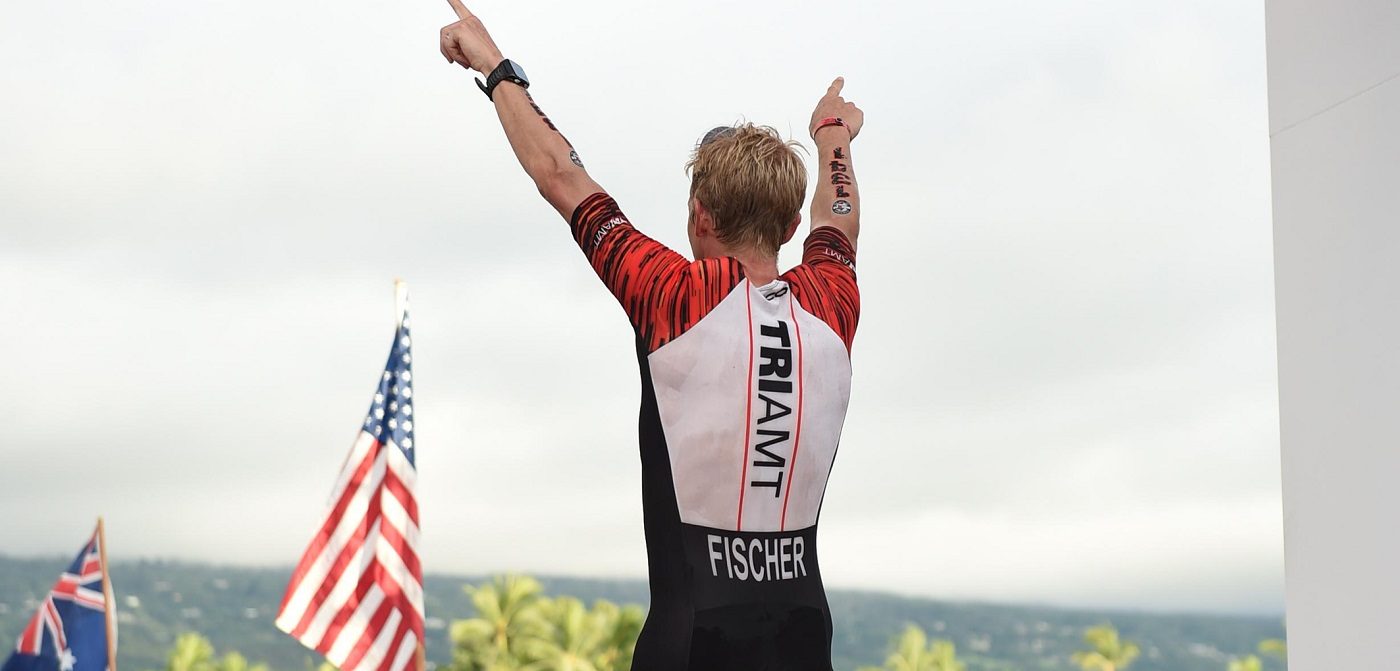
When I see my loved ones again as I turn back onto the highway, the worst of it is already almost forgotten. From here it is just a ten-kilometre home straight and a two-kilometre finishing run. Looking back, I can say that the Energy Lab’s notoriety is undeserved. It is mainly a myth. In reality it is only six entertaining kilometres, slightly downhill and back uphill, admittedly through a barren landscape, in the afternoon heat and without shade. Sure, it is not quite so hot today either... and yes, I did have to go through the low point of my race down there - but I could just as easily have thrown up somewhere else. In fact the Energy Lab is a proper cauldron of atmosphere, with plenty of spectators, a good mood and music. (While I was there they played ‘Little Red Corvette’ by Prince, among other things. - Brilliant!) On top of that there are a full five aid stations. I had imagined the Energy Lab as the very definition of triathlon hell, but that (for me) is definitely not what it is. The ten dreary kilometres to the airport and back are far harder. No spectators, only broken athletes. It goes slightly up and down the whole time, and you can see the stinking tarmac stretching ahead of you for miles, but not the finish. Now, on the way back, Kona hides treacherously behind the last rise of the highway. So you only really see the finish once you are almost there. It does not dangle in the distance beforehand as a little carrot. And there is no shade here either, just lava beyond the crash barriers and, every few kilometres, some ugly industrial buildings. But I have to enjoy them, my last kilometres on the road to fulfilling a lifelong dream - finishing Ironman Hawaii! What is a pleasure are the cups of ice-cold water and Coke handed out at every one of the many stations, right through until late into the night. What a logistical effort! And each station is around fifty metres long, stocked with sponges, ice, water, sports drink, Coke, Red Bull, gels, fruit, and then at the end sports drink, water, ice and sponges again. At every station nearly a dozen volunteers hand out thousands of paper cups over eleven hours - most of them in blazing heat. I alone take about six or seven of them every time. I run the last kilometres on the highway almost in a trance-like state. I have practically decoupled my external perception; there is nothing beautiful to see, hear or smell out here anyway. I am entirely within myself, in my emergency programme, suppressing every murmur of protest from the weaker self inside me. Getting to the finish has top priority. Second is reaching it before sunset. And a third one has now been added: keeping the marathon under four hours in spite of everything. To do that I have to run the remaining four kilometres in less than 25 minutes. That should work. Muscularly I have no pain, and no sign of cramp either. It is the heat that is setting my body’s limits. The third-to-last kilometre goes uphill again. At least it is already lined with Kona’s first commercial buildings. At the end of the road, music blares out of the hopelessly overwhelmed loudspeakers of Hannes Hawaii Tours. What a racket! The Germans have got the measure wrong again. Full-blown party beach. I have to cover my ears as I run past and turn into Palani Road. Here there are finally houses again, people, life at last. Two more kilometres to enjoy! The finish is so close that I can already hear the announcer: “... you are an Ironman!” At kilometre 41 my family are waiting for me. It is overwhelming that they are here now, to share the big emotions with me. Now, at the finish and at the end of a long road on which they were there for me, supported me and motivated me. Above all it was Eva who helped me make this dream come true. Without her backing, project Kona would not have been possible. I take them all in my arms, kiss them. And set off on the last kilometre. I make myself aware of how much I have invested to reach this goal: thousands of hours of training, tens of thousands of francs for equipment, gadgets, training camps, races. Years of building up experience, of knowledge about training theory and nutrition, of racing routine, and of refining technique in all four disciplines (transition being the fourth). I make myself aware of the many friendships whose foundation is endurance sport. I remember the encounters with all the people over those years; with those who do triathlon out of love for the sport, and with those who do triathlon out of love for themselves. I think of the many friends, colleagues and comrades who wished me luck, who might be thinking of me right now, lying at home in bed or sitting in front of the television. I live through the agonies of training and the pain of races once more, feel the wind and rain of Wales on my skin just as I feel my broken finger. I enjoy the endorphins after an interval session, feel the satisfaction after a finish and have my first and only running high once again, crossing the line in Tenby. All of this, and the indescribable, I carry in my heart and in my soul over the finish line of the Ironman in Kona, Hawaii. I look back one more time, over the final metres of my long road. Here, at the destination of my dream, I realise that it is not the place, the climate, the myths, the people or the organisation that make this race so unique for every athlete. It is the road that leads here. “Oliver Fischer, you are an Ironman!”
Post by Triamt


